Organic parenting for NYC families
A Practical Guide to Choosing Baby Bath Textiles
A baby’s bath may last only a few minutes, but the small routine that follows—lifting, drying, dressing—can shape the feel of the whole evening. The right textiles are soft, absorbent, easy to wash, and suited to the space and pace of family life. For New York City households, where storage can be scarce and laundry schedules demanding, practical details matter as much as fabric claims.
Published November 5, 2026
A small routine, a useful set of choices
Bath textiles are the towels, washcloths, mitts, and other washable fabrics used to dry or gently clean a baby. They sit close to delicate skin and are used repeatedly, so a good choice should work in ordinary circumstances: damp hands, a wiggly baby, a narrow bathroom shelf, and another load of laundry waiting its turn.
It is easy to be drawn first to words such as natural, pure, or gentle. Those terms may sound reassuring, but they do not tell the whole story. A more useful comparison starts with the fiber, the construction, the product’s dimensions, its care instructions, and any certification that applies. The goal is not to find a textile that promises perfection. It is to understand what it is made of and whether it suits your household.
Organic bath textiles are one option for families who prefer materials made from certified organic fibers. Organic status describes aspects of how fiber is grown and processed under a particular standard; it does not, by itself, establish that a towel is softer, more absorbent, or appropriate for every baby. Those everyday qualities depend on the finished fabric and how it is used and cared for.
Start with what touches the skin
Fiber and fabric construction influence how a towel feels, how quickly it takes up water, and how it behaves after repeated washing. Cotton is common in baby bath textiles because it can be made into fabrics with a range of textures and weights. A plush towel may feel cushioned; a lighter weave may be easier to fold, store, or pack. Neither quality automatically makes one textile better for every family.
Look for a clear material description rather than a broad claim. A label that says “100% certified organic Turkish cotton,” for example, gives more specific information than a product described only as “eco-friendly.” Details about where the cotton was grown or woven can provide further context, although origin alone is not a measure of performance or quality. If certification matters to you, check what standard is named and which parts of the product it covers.
GOTS, the Global Organic Textile Standard, is a certification system for textiles made with organic fibers and includes requirements related to processing and social and environmental criteria. A GOTS claim is useful information to evaluate, but it should not be treated as a medical guarantee or a promise that a product will prevent irritation. Babies vary, and a textile’s feel can depend on its weave, finishing, laundering, and individual skin.
For a newborn or a baby with particularly sensitive skin, keep the first wash simple: follow the care label, use a detergent your household already tolerates, and avoid adding unnecessary scented treatments. If a rash or persistent irritation develops, ask a pediatric health professional for guidance rather than assuming the textile is the cause.
Absorbency, softness, and drying time
A baby towel needs to take up water without making the drying process feel like a prolonged wrestling match. Absorbency is affected by the fibers and the fabric’s structure; softness is a separate sensation, not a reliable proxy for how well a towel dries. A very thick towel may feel luxurious but take longer to dry, while a thinner one may be easier to hang in a compact bathroom.
New towels can feel different after washing. Some become softer; others change in texture or loft. Product descriptions can offer clues—such as long-staple cotton or a plush construction—but daily use is the real test. Consider whether the towel feels manageable in your hands when wet, whether it wraps around your child comfortably, and whether it dries between uses in the place you plan to hang it.
In an apartment with limited ventilation or a shared laundry room, a towel that dries reliably may be more convenient than an especially thick one. Avoid leaving damp textiles bunched together in a hamper for long periods. Hang them open when possible, and wash them according to the care instructions. These simple habits help keep bath fabrics ready for their next use.
Washcloths and bath mitts serve slightly different purposes. A cloth can be folded or opened to reach different areas; a mitt fits over a hand and may feel easier to control for some caregivers. Neither is essential. What matters is gentle handling, clean textiles, and a bathing routine that follows current pediatric safety guidance.
What to look for in a hooded towel set
A hooded towel combines a drying surface with a section that can rest over the baby’s head after a bath. The hood is a practical design feature, not a substitute for close supervision or safe handling. A set that includes a matching mitt can make it convenient to keep two useful pieces together, but families can also build a small collection one item at a time.
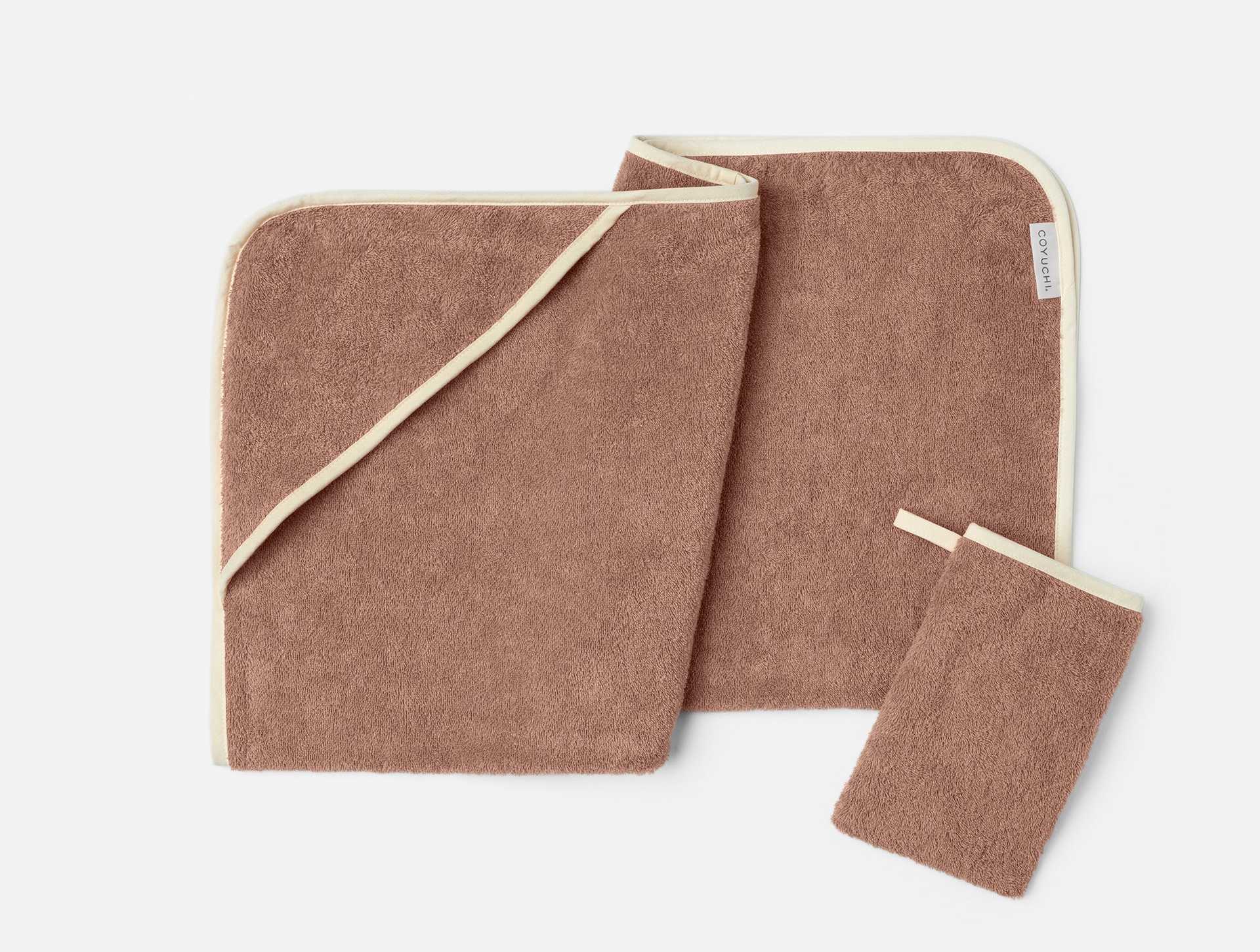
The Coyuchi Cloud Loom Organic Baby Hooded Towel and Bath Mitt Set is described as made from 100% certified organic Turkish cotton. The set includes a hooded towel measuring 31 by 31 inches and a bath mitt measuring 9 by 5.5 inches, with a hanging loop on the mitt. Its listed care instructions call for machine washing cold on a gentle cycle with like colors and tumble drying on low, removing it promptly.
Those specifications make it possible to assess practical fit before buying: the towel’s dimensions, the included pieces, and the care routine are all stated. A hanging loop may help keep the mitt accessible between washes. The cotton’s long-staple construction is described as plush and absorbent, but families should treat product descriptions as a starting point and consider their own preferences, available storage, and laundry setup.
Price and brand recognition are not substitutes for checking the details. Before choosing any set, read the current listing carefully to confirm materials, certification, dimensions, care directions, and availability. Specifications can change, and a product may be updated after an article is published.
The New York City test: space, transit, and laundry
In New York City, baby care often takes place in rooms that serve several purposes. A bathroom may have little shelf space, a laundry room may be down the hall or in the basement, and a stroller may carry supplies between home, a relative’s apartment, and childcare. Bath textiles should fit into that real map of daily life.
Before buying a multipiece set, consider where each item will live. Can the towel hang fully open? Is there room to keep clean textiles dry and separate from used ones? Will the mitt be easy to find, or is it likely to disappear among bath toys and washcloths? A compact stack of two or three reliable pieces may be more useful than a larger set that crowds a small cupboard.
Think about laundry access, too. If washing happens only once or twice a week, having a spare towel can keep routines flexible. If you use a shared machine, a product with straightforward machine-wash instructions may be easier to manage than one requiring special handling. Make sure the care routine is realistic for your household rather than assuming every textile will receive delicate treatment indefinitely.
Families who travel by subway or bus may also value a towel that folds neatly into a diaper bag. But a baby towel does not need to perform every task. A bath textile is not necessarily a sunshade, nursing cover, or safe sleep blanket simply because it is large or soft. Use products for their intended purposes, and follow relevant safety guidance for each setting.
Bath safety comes before fabric choice
Textiles can make a routine more comfortable, but they do not make bathing safe on their own. Babies need an adult’s undivided attention during a bath. Keep the supplies you need within reach before starting, and never leave a baby unattended in or near water, even briefly. If you need to step away, take the baby with you.
Follow current guidance from your child’s pediatrician and established public health sources for bathing, water temperature, and handling. A towel should be ready before the bath begins so there is no need to turn away to search for one. After lifting the baby, support them securely and dry gently, paying attention to folds of skin without rubbing hard.
A hood or a plush surface should not be interpreted as a safety feature. Nor should bath towels be placed in an infant’s sleep space. For sleep, follow current safe-sleep recommendations and use a firm, flat sleep surface with the appropriate fitted sheet and no loose soft items. Bath comfort and sleep safety are separate considerations.
These distinctions help keep product language in perspective. “Organic,” “breathable,” or “soft” may describe material characteristics, but none replaces supervision or established safety practices.
Care that helps textiles last
Frequent laundering is part of life with a baby. Milk, bath water, lotion, and everyday spills can all find their way onto towels and mitts. Follow the manufacturer’s care label, since washing and drying recommendations vary by fabric and finish. For the Coyuchi set described above, the listed instructions specify a cold, gentle machine wash with like colors and low tumble drying.
Using an appropriate amount of detergent can help avoid unnecessary residue. Fabric softeners and scented products are not required to make a towel usable; if you choose to use them, consider your family’s preferences and any advice from your child’s clinician. Avoid bleach unless the care label specifically permits it. Remove textiles promptly after drying, and store them only when fully dry.
Check seams, loops, and edges from time to time. A loose thread or damaged hanging loop can be a sign that an item needs repair or retirement. Replacing a towel because it no longer works well is more useful than keeping it simply because it was expensive or marketed as durable. When it is still in good condition but no longer needed for bathing, consider whether it can be repurposed for household cleaning or passed along in a clean, usable state.
A calm, practical checklist
Choosing baby bath textiles need not become a search for a perfect material or an elaborate collection. A short checklist can help narrow the options:
- Read the fiber description. Look for specific material information rather than relying on general words such as “natural.”
- Check the certification claim. Confirm which standard is named and what the claim covers.
- Assess texture and construction. Consider softness, thickness, absorbency, seams, and how the fabric feels when wet.
- Measure your space. Think about storage, hanging room, and whether the towel will dry between uses.
- Read the care label. Make sure its washing and drying directions fit your laundry routine.
- Choose a useful quantity. A small rotation of clean, dry textiles is often more practical than an oversized set.
- Keep safety separate from marketing. Textiles do not replace close supervision or current safe-bathing guidance.
For NYC families, the best choice is often the one that fits both the baby and the household: comfortable to handle, easy to launder, clear about its materials, and simple to store. Organic cotton may be meaningful to families seeking certified fibers, while dimensions and care instructions determine whether a particular towel works in everyday life.
The comfort of ordinary things
A baby bath is a small scene of water, warmth, and careful hands. The towel waiting nearby will not transform the routine, but it can make its final moments easier: a soft surface, enough room to wrap, a fabric that dries without fuss, and a place to hang it afterward. Those are modest qualities, yet they matter because they are used again and again.
When comparing Coyuchi or any other bath option, move beyond the name on the label. Confirm the current material and certification details, consider how the textile will fit into your home, and follow your pediatrician’s advice for bathing and skin concerns. A thoughtful purchase is not necessarily the most elaborate one. It is the one that meets a real need, with clear information and a care routine your family can sustain.