Nursery | Sleep and materials
Obasan Crib Mattress: Materials, Firmness, and Fit
A crib mattress is a quiet piece of nursery equipment with a demanding job: it must fit the crib precisely, provide a firm, flat surface, and withstand the practical rhythms of infant care. The Obasan organic crib mattress takes a materials-focused approach, combining organic Dunlop latex, coconut fiber, cotton, and wool. Understanding how those layers are described—and what they do not establish—can help families assess the mattress with care.
For a newborn, the sleep environment is not a decorative backdrop. It is a small, carefully prepared space where a baby spends many hours. In that space, attractive materials and environmental preferences matter to many households, but they do not replace the fundamentals: a mattress that fits the crib, a firm and level sleep surface, and a clear sleep area arranged according to current safe-sleep guidance.
The Obasan mattress is presented as a natural-material alternative to conventional mattresses. Its listed construction includes a firm layer of organic Dunlop latex, a base of rubberized coconut fiber, cotton, and moisture-managing wool. The manufacturer describes a removable cover and a standard North American crib size of 28 by 52 inches, with a thickness of 4.5 inches. Those details offer a useful starting point, not a substitute for checking the mattress label, the instructions for the exact model, and the crib’s requirements.
This guide looks at the materials, firmness, dimensions, maintenance, and safe-sleep considerations that matter when evaluating an Obasan crib mattress. It is informational rather than medical advice. For questions about an individual baby’s health or sleep, consult a pediatric clinician and follow current guidance from trusted public-health authorities.
What is inside the Obasan crib mattress?
The mattress description identifies several distinct materials. Each has a different role in the construction, and the words “organic” and “natural” should be understood as descriptions of materials and sourcing—not as proof that a product is automatically safer for every baby or suitable for every crib.
Organic Dunlop latex: a firm support layer
Dunlop latex is a form of latex foam made from natural rubber. In the Obasan description, one two-inch layer is identified as extra-firm organic Dunlop latex. Its role is structural support: it contributes to the mattress’s feel and helps form a stable sleeping surface. The precise firmness experienced at home can depend on the full construction, the cover, the mattress base, and the product’s condition. A materials list alone cannot tell a family whether a particular mattress meets the requirements for a specific crib or whether it feels appropriate for a particular infant.
Latex is also a material that warrants careful attention for households affected by latex allergy. Families with concerns should review the manufacturer’s information and ask a clinician for guidance. Do not infer from the word “organic” that allergy questions are irrelevant.
Coconut fiber: the firm foundation
The mattress is also described as having a rubberized coconut-fiber base. Coconut coir is the fibrous material found around the husk of the coconut. In mattress construction, it can be used to create a supportive core. The product description presents this base as part of a two-layer design, alongside the latex. The mattress’s support comes from the assembled construction rather than any one material considered on its own.
Families comparing crib mattress materials may encounter coir, foam, innerspring systems, latex, or combinations of these. The relevant question is not simply which material sounds most natural. It is whether the finished mattress is designed for the intended crib, has the required firmness and flatness, carries appropriate product information, and can be used and cared for according to its instructions.
Cotton and wool: cover, comfort, and moisture management
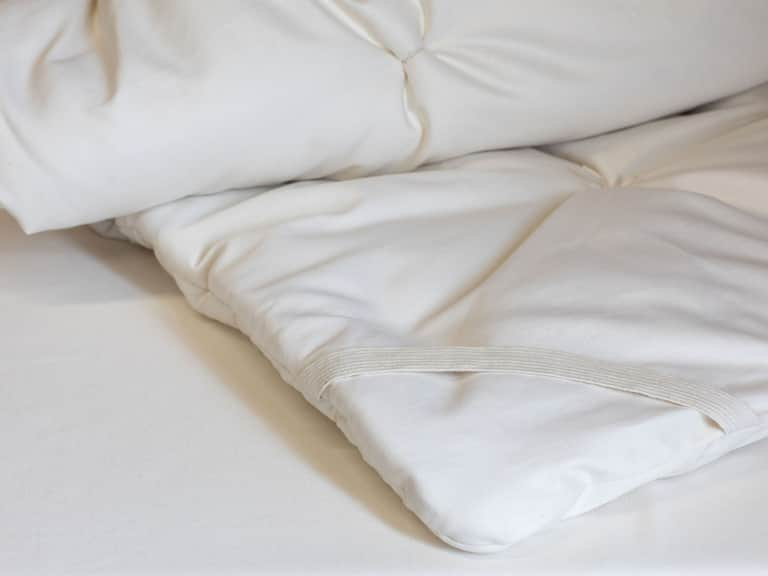
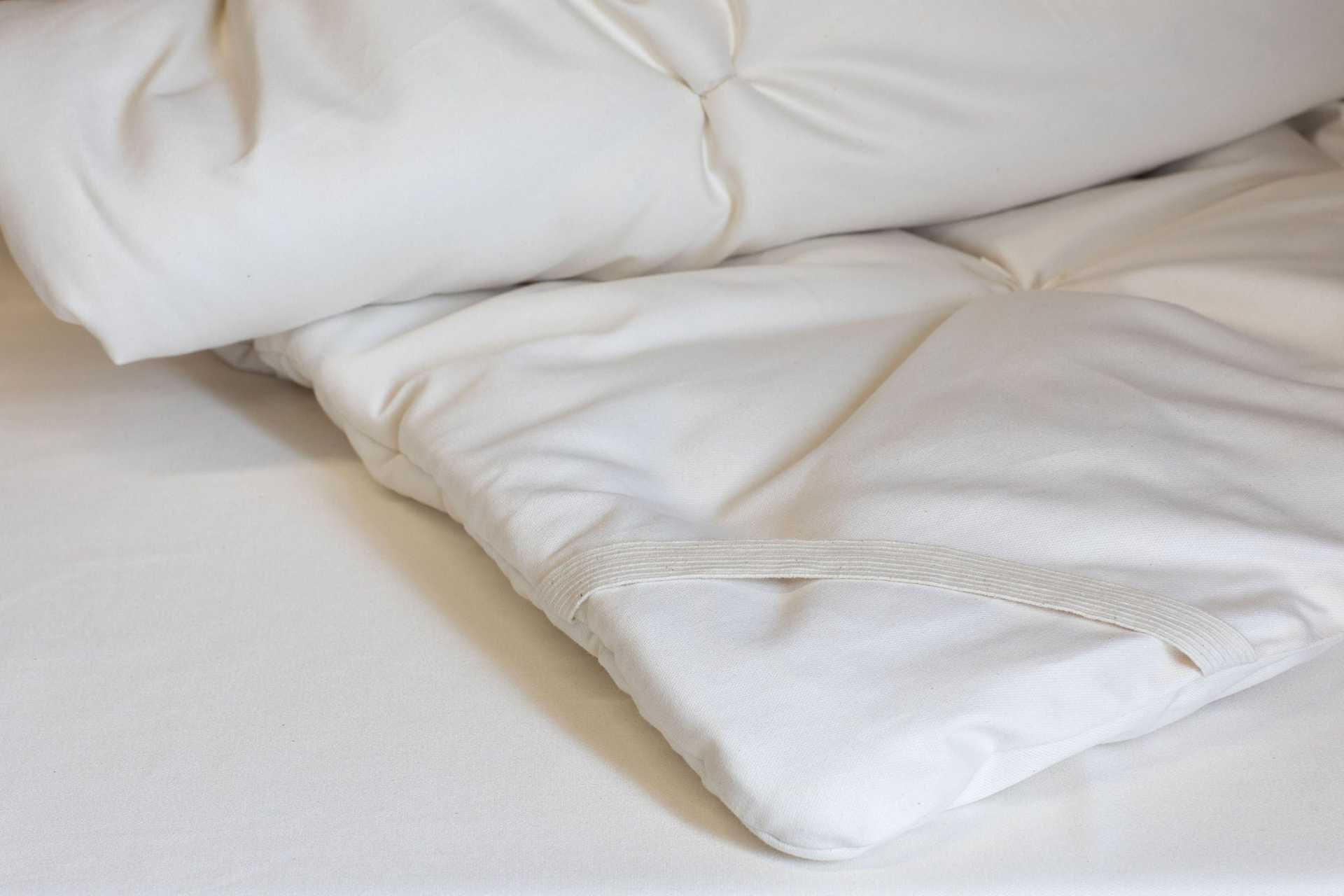
Obasan describes breathable organic cotton and wool in the mattress construction. Cotton is used in the cover, while wool is described as a moisture-wicking, temperature-managing component and as an all-natural fire barrier. In practical terms, these materials contribute to the product’s surface and construction choices. They do not make the mattress waterproof, and they do not remove the need to keep the sleep space uncluttered.
Wool and cotton may appeal to families seeking alternatives to synthetic materials. They also require attention to the manufacturer’s care directions. Natural fibers can be damaged by excessive water, heat, or inappropriate cleaning products. A mattress that is kept in good condition is easier to assess for fit and surface integrity than one with persistent moisture, tears, or a distorted core.
Certifications can help families understand how materials or production practices have been assessed, but certifications have specific scopes. Check the product’s current documentation to see which components are covered, which certification applies, and whether the label corresponds to the exact mattress model being purchased.
Firmness and infant sleep safety
For an infant, firmness is not a matter of personal comfort in the way it may be for an adult mattress. Safe-sleep guidance calls for a firm, flat, non-inclined surface designed for infant sleep, covered by a fitted sheet. The surface should not indent deeply under a baby’s weight or create a soft, uneven resting area. Follow the crib and mattress manufacturers’ instructions, and use a mattress that is intended for the specific crib.
The Obasan mattress is described as having an extra-firm latex layer and a firm-support coconut-fiber base. Those statements describe the product’s intended construction, but families should still check the exact product documentation and applicable safety information. If a mattress arrives damaged, has an uneven or sagging surface, or does not fit the crib properly, do not use it until the issue is resolved.
Keep the infant sleep surface bare apart from a correctly fitted sheet. Do not add pillows, quilts, comforters, loose blankets, stuffed toys, positioners, or other soft objects to an infant’s crib. A mattress pad or topper can change the surface and fit; do not add one unless the crib and mattress manufacturers’ instructions explicitly permit it and it is consistent with current safe-sleep guidance. In particular, a product being marketed as breathable, natural, or temperature regulating does not by itself establish that it is suitable for an infant’s sleep space.
For general safe-sleep information, families can consult the American Academy of Pediatrics’ published guidance and the U.S. Consumer Product Safety Commission’s resources. Recommendations can be updated, so check the current versions rather than relying on old checklists or informal advice. A clinician can help address questions specific to a baby’s medical circumstances.
- Place the baby on their back for every sleep, unless a clinician has given individualized instructions.
- Use a firm, flat sleep surface with a fitted sheet and no loose or soft items.
- Use the mattress only with a compatible crib and in accordance with both manufacturers’ instructions.
- Keep the sleep area free of added toppers, padding, and accessories unless specifically approved for that use.
- Stop using a mattress that is damaged, significantly worn, or no longer fits securely.
How to check crib mattress fit
Even a well-made mattress is not a safe choice for a crib if the fit is wrong. A gap around the mattress can create a hazard, while a mattress that is too large may bow, buckle, or fail to sit flat. The mattress dimensions are therefore more than a shopping specification: they are part of the match between two pieces of equipment.
The Obasan description lists dimensions of 28 by 52 inches and a thickness of 4.5 inches, identified as fitting standard North American cribs. Cribs are not all identical, however, and product labels and instructions govern. Confirm the size requirements for the exact crib model and compare them with the mattress label before use. If the crib is an older model, a mini crib, or an unusual design, do not assume that a standard-size mattress will fit.
After placing the mattress in the crib, check the fit around the entire perimeter. It should lie flat and remain stable; it should not bow or lift at the edges. The mattress should not shift in a way that leaves a visible space between its edge and the crib. If you are uncertain, contact the crib or mattress manufacturer rather than trying to correct the fit with rolled towels, extra padding, or improvised fillers.
Make the fit check again if the mattress is moved, replaced, or paired with a different crib. A used crib or mattress deserves particular scrutiny: confirm that it is intact, that the model information is available, and that the components are compatible. Avoid using a mattress that has been cut, altered, or repaired in a way not authorized by the manufacturer.
A practical fit checklist
- Read the crib’s label and manual for the required mattress dimensions and type.
- Check the mattress label for its measurements, model, and care instructions.
- Confirm that the mattress lies flat and remains stable within the crib.
- Look for gaps, raised edges, bending, or damage before placing the baby in the crib.
- Ask the manufacturer for help if the fit is uncertain; do not fill gaps with household items.
Care, cleaning, and everyday maintenance
Natural mattress materials are not necessarily wash-at-home materials. The Obasan care instructions say to open the mattress within 30 days of receiving it and to protect it with a wool moisture pad or equivalent protection. For spot cleaning, the instructions call for unzipping the outer cover and gently cleaning with light soap and very little water. They state that mattress components should not be washed, that the mattress should be air-dried, and that it should not be placed in direct sunlight or near a direct heat source.
The removable cover may be aired seasonally, according to the product information. The manufacturer also notes that the casing may be environmentally dry cleaned if needed, while warning that it is not responsible for the outcome of dry cleaning. Because cleaning methods can affect natural fibers and the mattress structure, read the current care label before acting. Instructions can vary by model or production version.
For routine care, handle the mattress gently and allow it to dry fully after any permitted cleaning. Do not soak the core or use bleach, harsh chemicals, or unapproved treatments. If a spill reaches the interior, if a persistent odor develops, or if the cover or structure is damaged, ask the manufacturer how to proceed. A moisture barrier or pad should never be used if it changes the surface, creates bunching, or interferes with a secure fit.
Periodic inspection is simple but useful. Look for tears, compressed areas, unevenness, loose seams, or changes in the mattress’s shape. Check that it still sits properly in the crib and that the fitted sheet remains secure. A mattress protector cannot compensate for an unsuitable or damaged mattress, and more layers are not automatically better.
Choosing an organic crib mattress with clear eyes
Organic materials can be an important preference for families, especially when they want to understand what is in a nursery. Yet the term “organic crib mattress” is not a complete buying checklist. Look beyond the headline claim and examine which materials are used in each layer, what certifications apply, whether the product is intended for infant sleep, and how it is tested and labeled.
Compare the complete mattress rather than a single attractive feature. A natural cover does not tell you what is inside the core; a breathable material does not establish safe sleep on its own; and a certification for one textile component may not cover every part of a finished mattress. Ask the manufacturer for the model-specific details that are not clear in the product description.
For the Obasan model, the stated construction—organic Dunlop latex, coconut fiber, cotton, and wool—may interest households looking for a mattress without synthetic foam or vinyl waterproofing. The product is described as handcrafted in Canada, with a removable cover and a 10-year limited warranty. Review the warranty terms, exclusions, delivery and unpacking instructions, and current certification documents before purchasing. Those details help set realistic expectations about use and longevity.
Families comparing options can also read the Obasan Organic Crib Mattress product information alongside the crib manual. Treat marketing language as a prompt to investigate rather than as a substitute for dimensions, care instructions, and safety details.
Questions to ask before buying
A short set of questions can make a detailed product page easier to navigate. They also help separate measurable features from broad claims about comfort or wellness.
- Does this model match my crib? Confirm the precise dimensions and compatibility with the crib manufacturer.
- Is the mattress intended for infant sleep? Look for clear product labeling and use instructions.
- What makes up each layer? Identify the core, cover, fill, waterproofing, and fire-barrier materials.
- What does each certification cover? Check the certificate or current product documentation rather than assuming every component is included.
- How should it be cleaned? Keep the care instructions available and follow them closely.
- What is the return and warranty policy? Understand how defects, shipping damage, and ordinary wear are handled.
- Can I use a protector or topper? Confirm whether the manufacturers permit it and whether it preserves a firm, flat, secure sleep surface.
A considered place to begin
The Obasan crib mattress is built around a distinctive combination of organic Dunlop latex, rubberized coconut fiber, cotton, and wool. Its material choices may appeal to families seeking a natural construction, while its listed 28-by-52-inch footprint and 4.5-inch thickness offer concrete points for a fit check. The mattress’s care instructions—especially the limits on washing and the guidance to use very little water—are equally important parts of ownership.
Ultimately, the central question is not whether a mattress sounds natural, but whether the exact product is compatible with the crib, remains firm and flat, and is used without additions that compromise the sleep surface. Verify the measurements, follow the manufacturer’s care and installation directions, and keep the infant’s sleep space clear. When materials, fit, and safe-sleep practice are considered together, families can make a more informed decision for the nursery.